
There is a difference between repair and replacement.
In December of 1967, in Cape Town, South Africa, the first human heart transplant was performed. A surgeon took out a failing heart and placed in another one. It was radical. It was invasive. It was, in a way, the literal form of an old poetic longing: a dying man given a new heart. The old heart was not strengthened. It was not restored. It was removed.
That helps us feel the force of Ezekiel 36. God does not merely say he will encourage us, improve us, or help us manage our interior life a little better. He says he will remove the heart of stone and give a heart of flesh. That is not cosmetic. That is not surface-level. That is a Creator speaking about recreation.
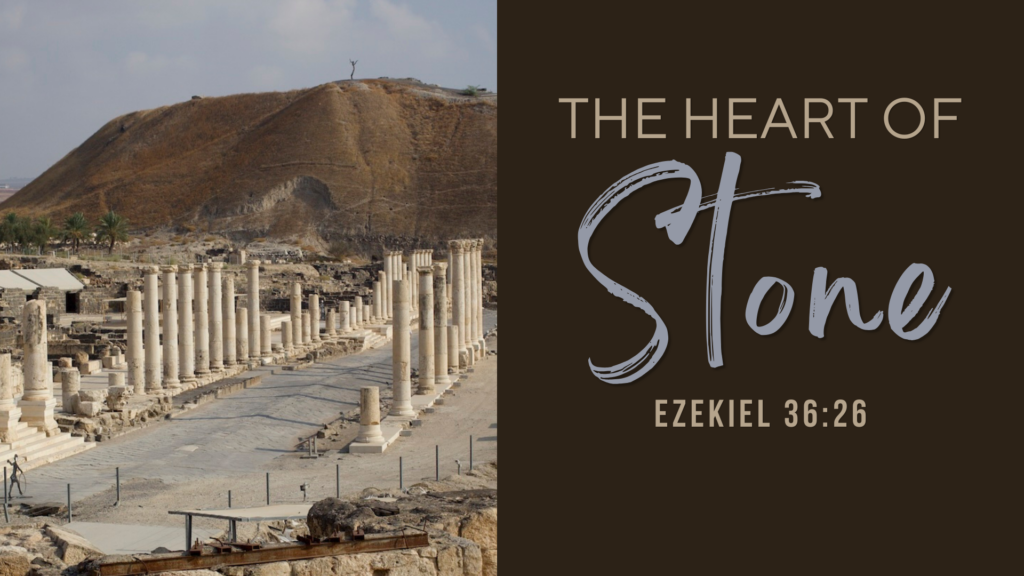
A heart of stone does not usually arrive all at once. It layers up. Sin layers up. Hurt layers up. Shame layers up. Family history layers up. Culture layers up. What was done to you, what was modeled for you, what you chose yourself, what you inherited without asking for it, all of it can settle into the inner life like city upon city upon city in an archaeological tell. You dig down and find more rubble, more fracture, more evidence that something stood there once and then fell.
That is why the burden feels older than you, because it usually is.
We are not our own creation. We are marked by the stories of those who came before us. Some of us are carrying fear that was in the house long before we were born. Some are carrying rage, addiction, silence, shame, abandonment, or grief that has moved through generations like a current. It goes deep and it goes back. That is what makes the promise of God so necessary. If all he offered was self-improvement, we would be stuck. If all he offered was better coping, we would still be carrying the same stone.
But God says, I will remove it.
I do not think it is an accident that Jesus was a builder. A tekton. Not only someone who worked with wood, but with stone. He would have known how to test a stone, shape it, place it, and tell whether it could bear weight. He knows what is sound. He knows what is fractured. He knows what has become useless for building. He knows us that way too. He knows the cracks better than we do.
And still he comes close.
At Calvary, Jesus died for the weight we could not carry and could not fix. The rejected stone became the cornerstone. The one humanity pushed aside became the only stable place to build a life. That is the gospel. The gospel isn’t the good news that we finally sort ourselves out, it is that the Master Builder takes what we cannot repair and does what only he can do.
He creates a new heart. A new spirit. A new creation.
So give him the whole thing. Not the cleaned-up version. Not the polite church version. The whole thing. The heavy thing. The old thing. The thing that has been hanging around your neck and holding you down.
Create in me a clean heart, oh God.